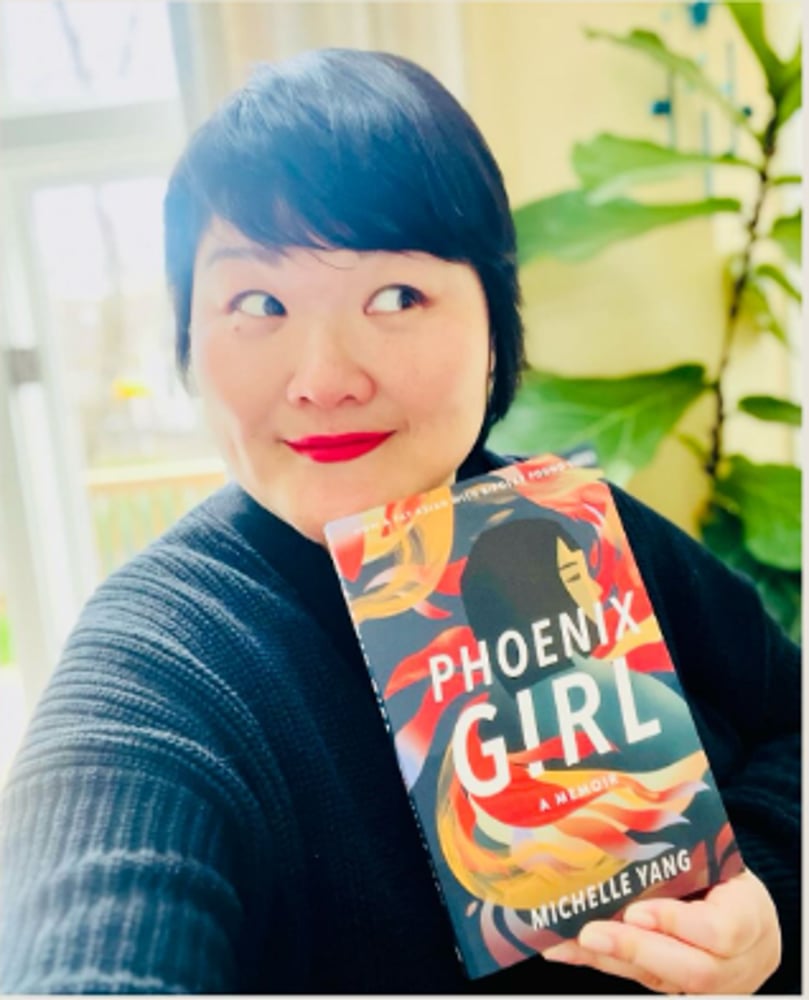
Michelle Yang is a Michigan-based mental health advocate, writer, and author of the memoir Phoenix Girl: How a Fat Asian with Bipolar Found Love. Michelle lived the first nine years of her life in a country that did not have birthright citizenship. Despite being born in South Korea and being the third generation of her family to live in South Korea, Michelle did not have South Korean citizenship. When she came to the United States at age nine, Michelle had already formed an astute understanding of birthright citizenship.
For those of us who have only lived in the U.S., the threat of getting rid of birthright citizenship can sound abstract because it has been the law of the land for as long as anyone can remember. But you were born in a country that does not recognize birthright citizenship – what was that like?
I was born in Incheon, South Korea, where birthright citizenship does not exist. My parents were also born in South Korea. But we are ethnic Chinese. My grandparents immigrated to South Korea from Shandong Province, China. At the time, South Korea had a system of citizenship based on your father’s nationality, instead of birthright citizenship. So, I had Republic of China-Taiwanese citizenship even though I had never lived there. Despite being the third generation in South Korea on both sides of my family, I did not have Korean citizenship.That meant not having the right to vote, or to buy property. There was a New York Times article about how Chinatown in Incheon is so much more abandoned now–hundreds of thousands of people have left because of the lack of rights.
As a child, how much or how little did you understand about your citizenship status? Were you aware that you were not a citizen of your country of birth and residence?
I was aware. It was apparent just from day-to-day living in Korea. I remember going to school on Korean Children’s Day, and the Korean children would ask us why we had to go to school. We had to explain, “We are Chinese. Our Children’s Day is April 4th, not May 4th.” It seemed like us versus them. Even though we had Korean friends, in the general community, we did not belong. It was very clear who is not Korean in Korea. To try to help me fit in, my parents chose my name very intentionally. My name means beautiful jade. It’s a name that sounds natural in Mandarin and Korean. My parents had names that couldn’t hide their Chinese identity. They were very careful in choosing a name for my brother and me, hoping that we could pass.
Your parents decided to leave South Korea and come to the United States, bringing you and your brother. What was their motivation for immigrating to the U.S?
After high school, both my parents left Korea to go to college in Taiwan. My parents met during college. After finishing college, they moved back to Korea because that was all they had known. Korea was home for them. My dad took a job as a teacher at a Chinese school in Incheon, a school that my grandfather had helped build. His salary was low, and his career opportunities were limited. He realized that the best he could do, if he stayed in Korea, was become principal of the school, and he didn’t want that job. They wanted choices and better opportunities. They didn’t want their experiences to be repeated for my brother and me. They wanted better education and opportunities for us.
You first learned about birthright citizenship not in school, but through your experience as a child who wasn’t granted citizenship by your country of birth. Do you recall being taught birthright citizenship in school?
I went to high school in Phoenix, Arizona. I was taught about birthright citizenship as part of our constitutional rights curriculum because of a special teacher. Even so, I didn’t learn about Wong Kim Ark through school. But because of my experience, this is a topic I have been talking about since I was young. I remember having a debate in high school government class. The topic was whether the Constitution should be changed to allow for naturalized citizens to become President of the United States. My team chose to argue for removing the requirement to be a U.S.-born citizen in order to run for President. I had to explain to my classmates that, because I am not a U.S.-born citizen, I don’t have the right to run for President of the United States. I talked to my classmates about birthright citizenship and how my citizenship is not something I take for granted. As an immigrant, these were the types of things that I would call to attention to my classmates who might not otherwise pay attention to this stuff.
What was your reaction when you first heard about Trump’s executive order seeking to end birthright citizenship?
When I heard about the executive order, I felt grief. I was not born in the U.S. I am a naturalized citizen. I immigrated to the U.S. when I was nine and I became a citizen when I was sixteen. In Korea, I was three generations in, and still could not earn my citizenship. Getting U.S. citizenship for my family was not easy. My aunt petitioned for our immigration, and it took ten years before we were granted permission to immigrate to the U.S. We were privileged: we had relatives in the U.S; we had documented demonstration of income, and it still took us over ten years. Many people don’t have all this privilege. And in Korea, we were denied the opportunity entirely.
As a nation, what do we stand to lose if the U.S. no longer recognizes birthright citizenship?
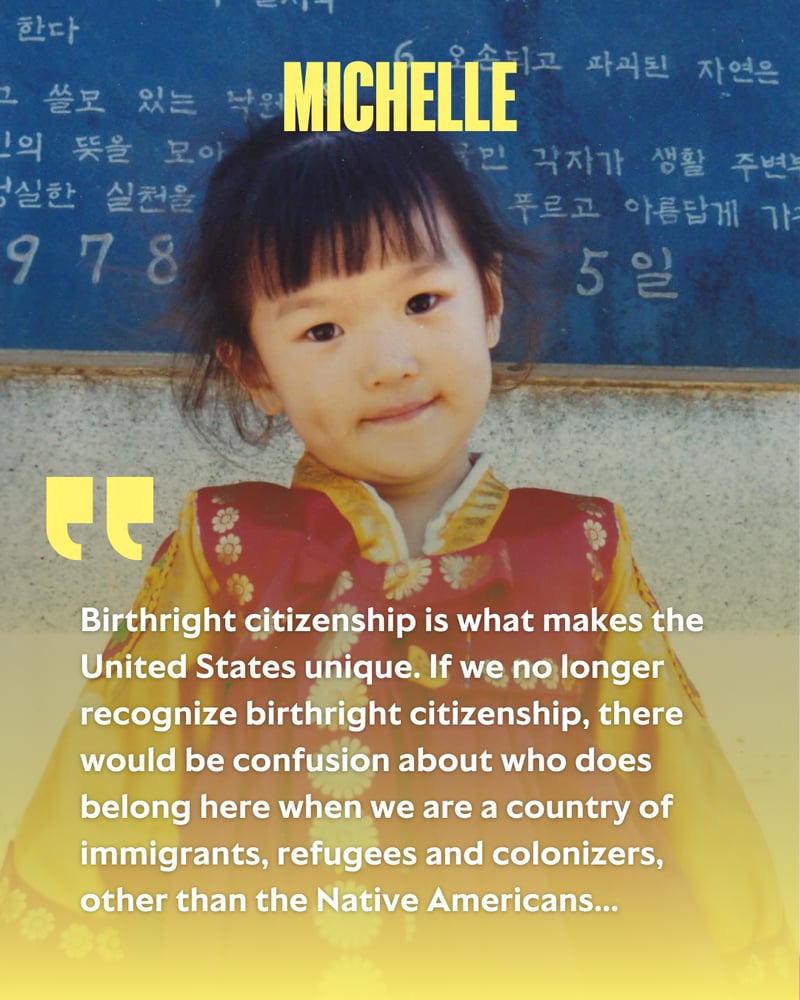
I think it would need to be someone’s fulltime job to sit and think through all the consequences that would come from losing birthright citizenship. It would mean losing this dream, this ideal, of America that everyone can belong here. Birthright citizenship is what makes the United States unique. If we no longer recognize birthright citizenship, there would be confusion about who does belong here when we are a country of immigrants, refugees and colonizers, other than the Native Americans who have been here. Getting rid of birthright citizenship would be a statement: We are a selfish country now. Those of us who were lucky enough to get behind the gate are now shutting it. Even the thought of getting rid of birthright citizenship is overwhelming. Would that mean we will switch to a paternal system? What about nonbinary parents? The logistics itself is overwhelming. It's sad to think about. A lot of parents are proud that their kids get to be born as American citizens because it is something they had to struggle to achieve. To have that taken away would be quite sad.
Where is home for you? What does belonging mean?
I live in Michigan. I moved here over four years ago from Seattle. Belonging is a tough question. I never really felt like I belonged anywhere, which makes having the legal ‘I-belong-here’ all the more important. During the first nine years of my life, I lived in one country but, on paper, I belonged to another. It was not until I was 16 and became a U.S. citizen did I get to say: I live here. I belong here. This is my home and my country. I can vote here. That is a right that my family did not have for generations as ethnic Chinese in Korea. I am an American, and I don’t take it for granted. I don’t take criticizing this country lightly. Until Trump’s presidency, I tended to be defensive of the American government and American ideals. But what I remember about growing up in Korea in the 80s is now happening in the United States.
When I was a child, student college protesters were being arrested in Korea. The government used tear gas against students. My family ran a bathhouse in Korea, and we lived on the second floor. Our business was near a college campus, and I remember someone putting up a ‘wanted’ poster outside of our business with student ID photos. These students were wanted for arrest because they were demonstrating for democracy. They all just looked like older sisters and brothers to me. The tear gas was so bad that my parents would take us to stay with their friends in a different neighborhood so we wouldn’t have to breathe the bad air. Now, I see this happening in my country. Trump has openly claimed to arrest people for protesting. What’s happening right now breaks my heart.
You are a writer who focuses on the intersection of Asian American identity, feminism, and mental health. Why do you do this work? How did you come to discover your passion?
Toni Morrison said, "If there is a book you want to read but it hasn't been written yet, you must write it yourself." I was very inspired by this quote. When I was struggling right after my bipolar diagnosis at age 20, just out of the hospital, I went to the library to find a book about just one person whom I could hold up as an example. I wanted even one example that a person could live a full life with bipolar. I wanted to find a book about someone I could relate to, preferably someone who was BIPOC or an immigrant, who was writing about the issues that I lived through. I couldn't find it when I was 20 and I couldn't find this book when I was in my late thirties either. So when I had a mid-life crisis burnout point at my corporate job, asking myself what my life's mission is, I decided to tell my story for my younger self and anyone else who lives with similar struggles.
Note: This interview has been edited for length and clarity.