Author

Aisa Villarosa
Manager, Asian American Leaders Table
Aisa Villarosa
Manager, Asian American Leaders Table
Managed by Asian Law Caucus (ALC), the Asian American Leaders Table (AALT) is a national network convened since Spring 2020 to coordinate rapid response, information sharing, and advocacy solutions on anti-Asian hate. In January 2025, the AALT met to discuss the Trump administration’s impact on immigrant and refugee communities–and how AANHPI groups can find alignment with the broader fight for immigrant rights, protections, and safety.
In the coming months, we will continue to share AALT insights, resources, and calls to action.
Anti-Asian and Anti-Immigrant Hate, from the Atlanta Spa Shootings to Trump 2.0
In 2021, a white shooter took the lives of eight people–most of them Asian women and members of Atlanta’s immigrant community. The resulting outcry demanded responses to help address racially motivated violence, fueled by the xenophobic rhetoric of Donald Trump’s first presidency. A renewed mandate emerged, to keep each other safe, and to center those most vulnerable to hate and oppression. Toward this effort, and to strengthen solidarity among racial and ethnic groups too often pitted against each other, the Asian American Leaders Table (AALT) formed a national network to strategize on, prepare for, and coordinate rapid response efforts following anti-Asian harm.
Nearly five years after the Atlanta Metro spa shootings, Trump is once again president, and the mandate to keep our communities safe remains–including from anti-immigrant hate allowed and even carried out by the federal government.
Since Day One, the second Trump administration has sought to isolate and fatigue, ultimately to tear apart families while causing chaos in local neighborhoods and economies. This dangerous anti-immigrant moment is an urgent call to reground Asian American, Native Hawaiian, and Pacific Islander (AANHPI) communities in solidarity with those denied safety because of their skin color, languages spoken at home, or citizenship status, including millions of Asian, Black, Latinx, Middle Eastern, and LGBTQ+ immigrants and refugees.
Asian Americans are the fastest growing immigrant community in the United States, and the only U.S. racial group that is majority immigrant. Our identity is inseparable from the immigrant and refugee experience, and our voices are critical in the fight for immigrant lives. AALT members have been unpacking some of the biggest threats of Trump’s second presidency, especially for undocumented and mixed status families, and strategizing on how AANHPI groups across the country can come together and respond.
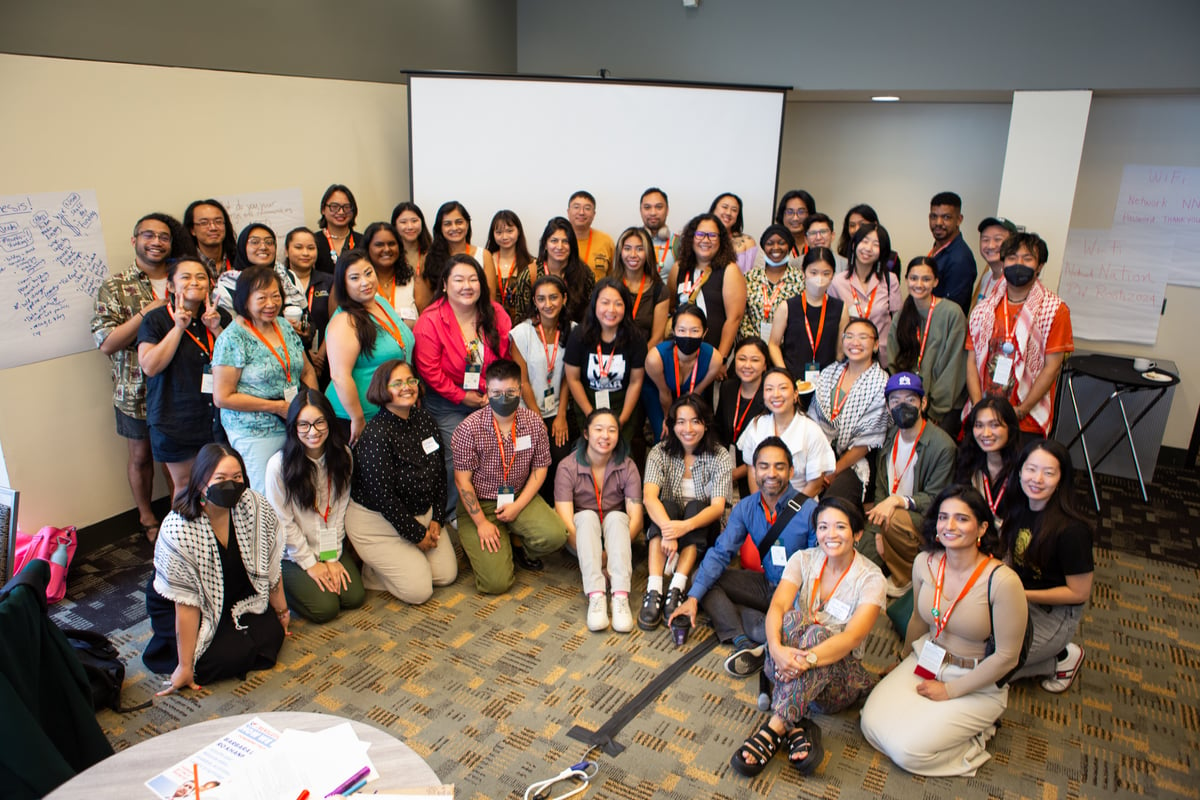
Over 20 AALT member organizations co-hosted the Asian American, Native Hawaiian, and Pacific Islander Caucus during the July 2024 NetRoots Conference. The groups connected, explored models of AANHPI solidarity, and mapped opportunities for cross-racial collaboration, and healing and repair. | Photo: Kitty Hu
Trump’s Anti-Immigrant Actions Are Cruel, Inhumane, and Hurt All of Us
In January 2025, the Trump administration released more than 50 executive orders, along with memos and agency guidance, with many intended to ramp up mass deportation, racial profiling, and anti-immigrant hate. Trump’s earliest executive actions:
- Attempt to deny undocumented immigrants public benefits and allow immigration enforcement raids in trusted spaces like schools, churches, and hospitals;
- Escalate travel screening procedures and federal enforcement for those who “bear hostile attitudes toward [United States]...culture,” which will most harm AANHPI, Black, African, Arab, Middle Eastern, Muslim, and South Asian (BAMEMSA), Latinx, and immigrant communities, as well as student activists;
- Seek to end birthright citizenship–the constitutional right that everyone born in the U.S. is a citizen–and undermine sanctuary protections, which ensure local and state resources cannot be used to carry out federal immigration enforcement in our communities;
- Declare funding freezes and program terminations impacting hundreds of human rights nonprofit and government organizations in the U.S. and across the world, as well as calls to end diversity, equity, and inclusion and race-conscious funding, programming, and data collection;
- Attempt to force a federal gender binary that targets trans people, resulting in U.S. passport application denials of LGBTQ+ individuals, and galvanizing state and local anti-LGBTQ+ policies on bathroom bans, sports bans, and attacks on gay marriage; and
- Overall, push toward reversing decades of civil and human rights progress with an anti-progressive, anti-immigrant Project 2025 vision and agenda.
While many of these executive actions are blatant violations of Equal Protection and other constitutional rights, overcoming them will require rigorous organizing and community power–particularly with Congress, the Supreme Court, and a federal court system all increasingly compliant with the Trump administration. If Trump’s pledges and executive actions are left unchecked, an estimated 28 million people – about 1 in 12 total U.S. residents – are at risk of family separation in 2025, including over 5 million U.S citizen children.
AALT Member and Collaborator Recommendations for AANHPI Groups
While the executive threats require new levels of organizing, our movements are better equipped and more connected in key ways. Many networks, including AALT, came together over the past decade, as a result of organizing wins in response to Trump’s first term and countering the rise in anti-Asian hate violence. These networks can be a foundation for collective action across diverse groups, with potential for rallying around unified campaigns or strategies.
Three ways AANHPI groups can answer the call to build power for immigrant rights – right now – are below.
- Take on anti-immigrant hate, including as a systemic form of anti-Asian hate. From long standing immigrant rights nonprofits to newcomers in the space, all AANHPI groups must meet this moment–balancing their unique role and strengths with the wide spectrum of ways to show up for immigrant and refugee communities. Fortunately, organizations, like many in the AALT, doing the hard, essential work of helping AANHPI communities understand and challenge systemic anti-immigrant attacks as a government-induced form of anti-Asian hate are not alone: Data-driven frameworks, including AAPI Data’s new research on AANHPI immigration trends and anti-AANHPI hate, contextualize the history, struggles, and opportunities shared amongst AANHPI and immigrant groups. These frameworks, along with legal, narrative, and Know Your Rights resources listed in AALT’s Rapid Response Table, can help groups host training and education opportunities for their members to reflect on and discuss the impacts of executive actions.
- Bolster support for existing immigrant rights networks. Joining, coordinating with, or uplifting advocacy and organizing cohorts like the Detention Watch Network and NILC’s Education for All campaign, along with immigrant-led base-building coalitions like NAKASEC and Grassroots Asians Rising, can diminish isolation, especially in times of crisis. NAKASEC offers virtual volunteer trainings to support emergency and Know Your Rights hotline efforts, as well as a downloadable Know Your Rights app in 19 different languages.
Additionally, neighborhood or regional networks can keep groups locally informed while generating Know Your Rights trainings and resources. In the Bay Area, for example, individuals can sign up for local pods to plug into existing networks leading grassroots mobilization.
- Join community campaigns paired with legal challenges. In the coming months, emerging legal challenges to protect birthright citizenship and other rights will be accompanied by community-driven campaigns. These campaigns are opportunities to strengthen cross-racial solidarity by showing how Trump’s executive actions attack people’s rights across race, ethnicity, and identity: Both birthright citizenship and sanctuary protections, for example, were originally used to safeguard Black lives and oppose slavery centuries ago, and have continued to help protect the safety, wellbeing, and legal rights of Latin American, African, Caribbean, and Asian immigrants and refugees.
The next four years will require extraordinary collaboration, creativity, and compassion. There is no better time for Asian, Native Hawaiian, and Pacific Islander communities, including groups created to confront anti-Asian violence, to fully honor our immigrant legacy and unite our networks, skills, and strategies for immigrant lives. As Jose Antonio Vargas recently asked: “Dear America: What are you going to do—what are you willing to risk—to protect your undocumented friends, classmates, and neighbors?”
The Asian American Leaders Table (AALT) is a national network of over 70 movement groups committed to mutual support, coordination, and collective action toward addressing the root causes of hate and building community power. If you are interested in learning more, please contact us at asianamtable@gmail.com.

AALT members from OPAWL, NCAAT, and Legacies of War share members' recommended books as part of a community book exchange at the 2024 NetRoots Conference. | Photo: Kitty Hu