On November 4, 2025, voters in California will vote on Proposition 50, an initiative to adopt a new congressional district map in the state.
Proposition 50 asks voters to approve new congressional district lines proposed by the state legislature. The governor and the state legislature have supported this initiative in response to the Texas legislature’s decision to redraw Texas’ map to create five new Republican congressional seats. If passed, Proposition 50 would create five new Democratic congressional seats in California. The new congressional lines would stay in place until 2031. In 2031, California’s independent redistricting commission will draw the next set of congressional districts.
This page includes informational resources created by Asian Law Caucus for the November 4, 2025 Special Election, including Frequently Asked Questions, a How to Vote factsheet, and an interactive map of the existing congressional lines and proposed lines.
- Frequently Asked Questions (see below) | Also available in Arabic, Hmong, Korean, Simplified Chinese, Spanish, Tagalog, Traditional Chinese, Vietnamese
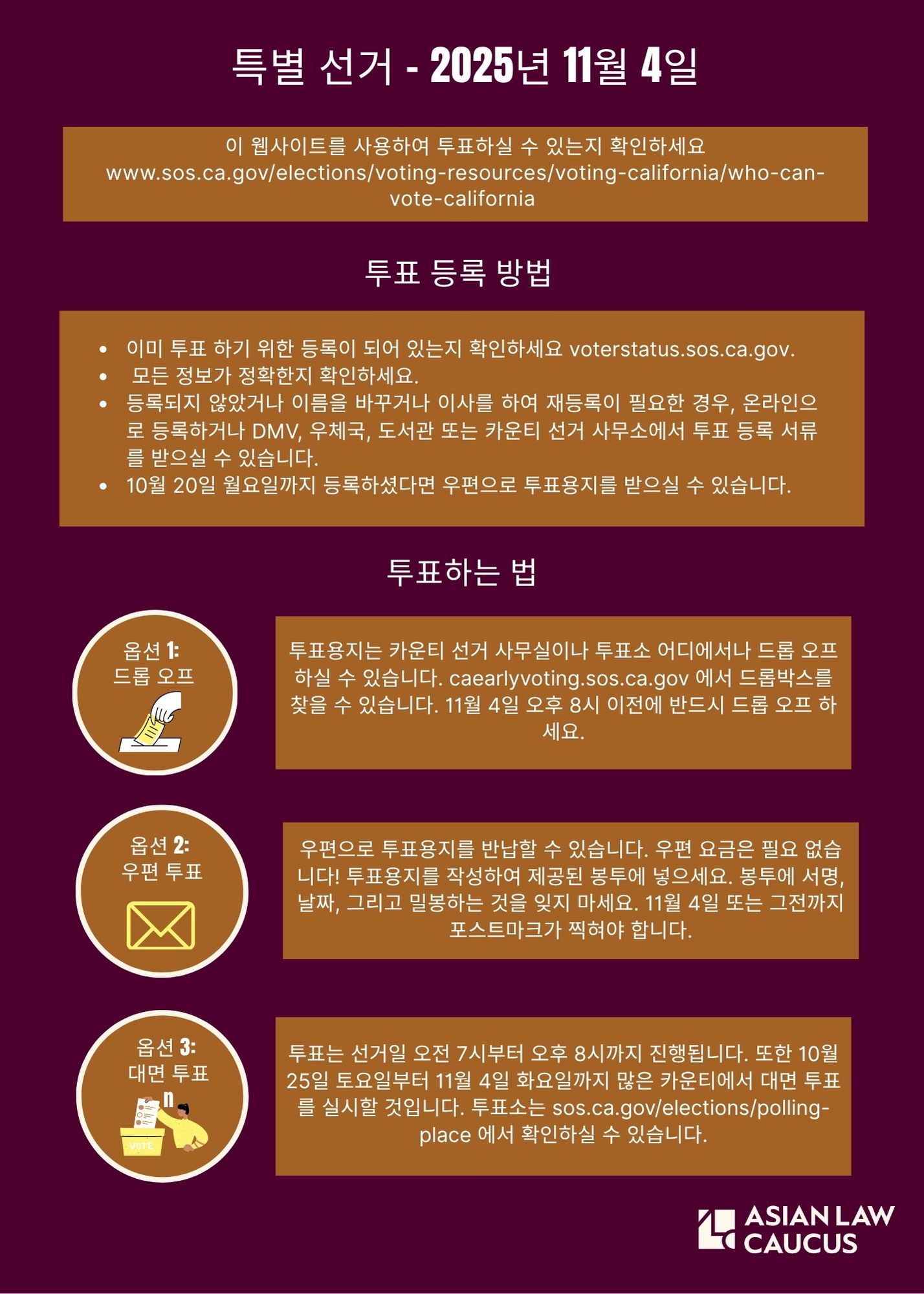
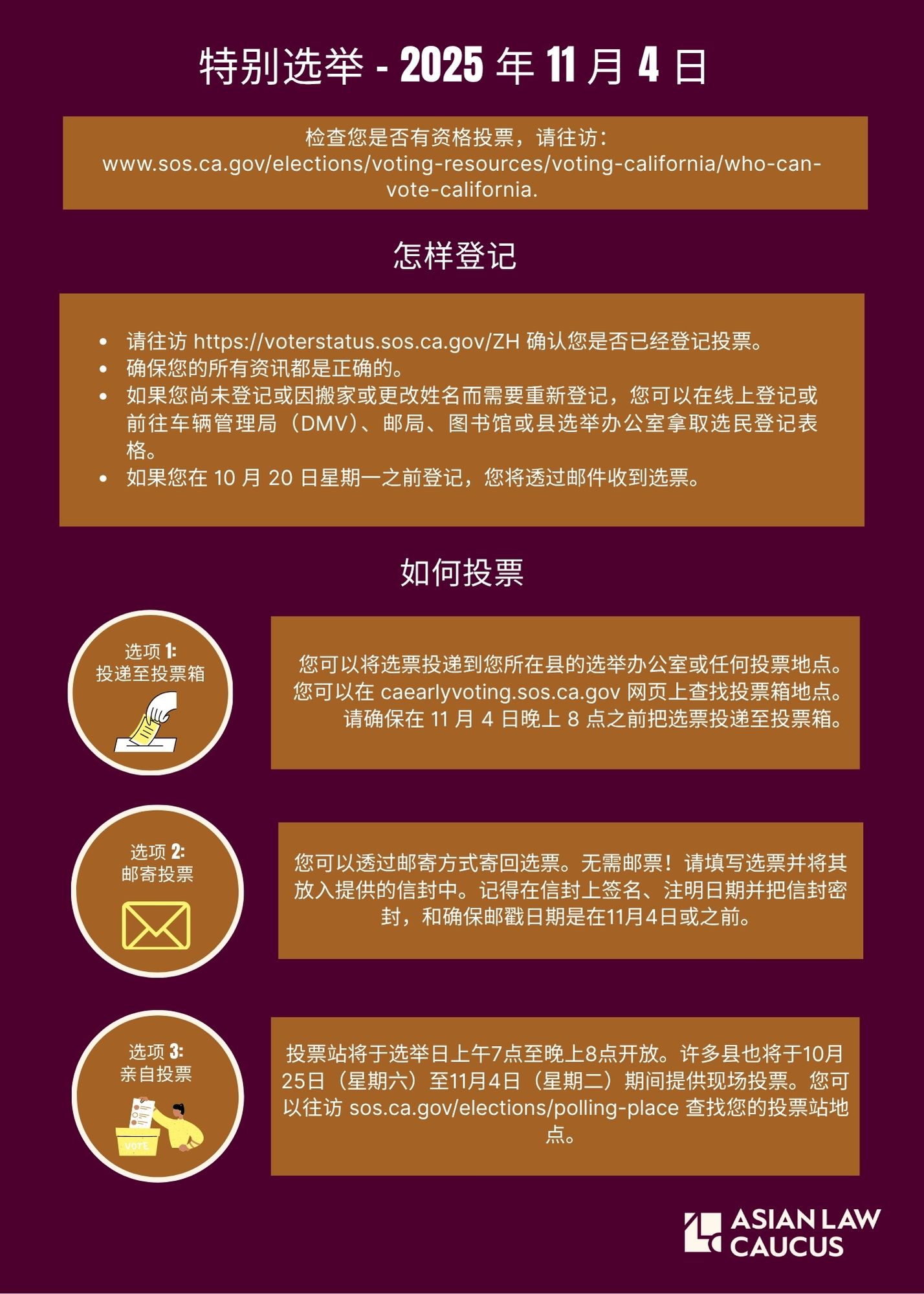
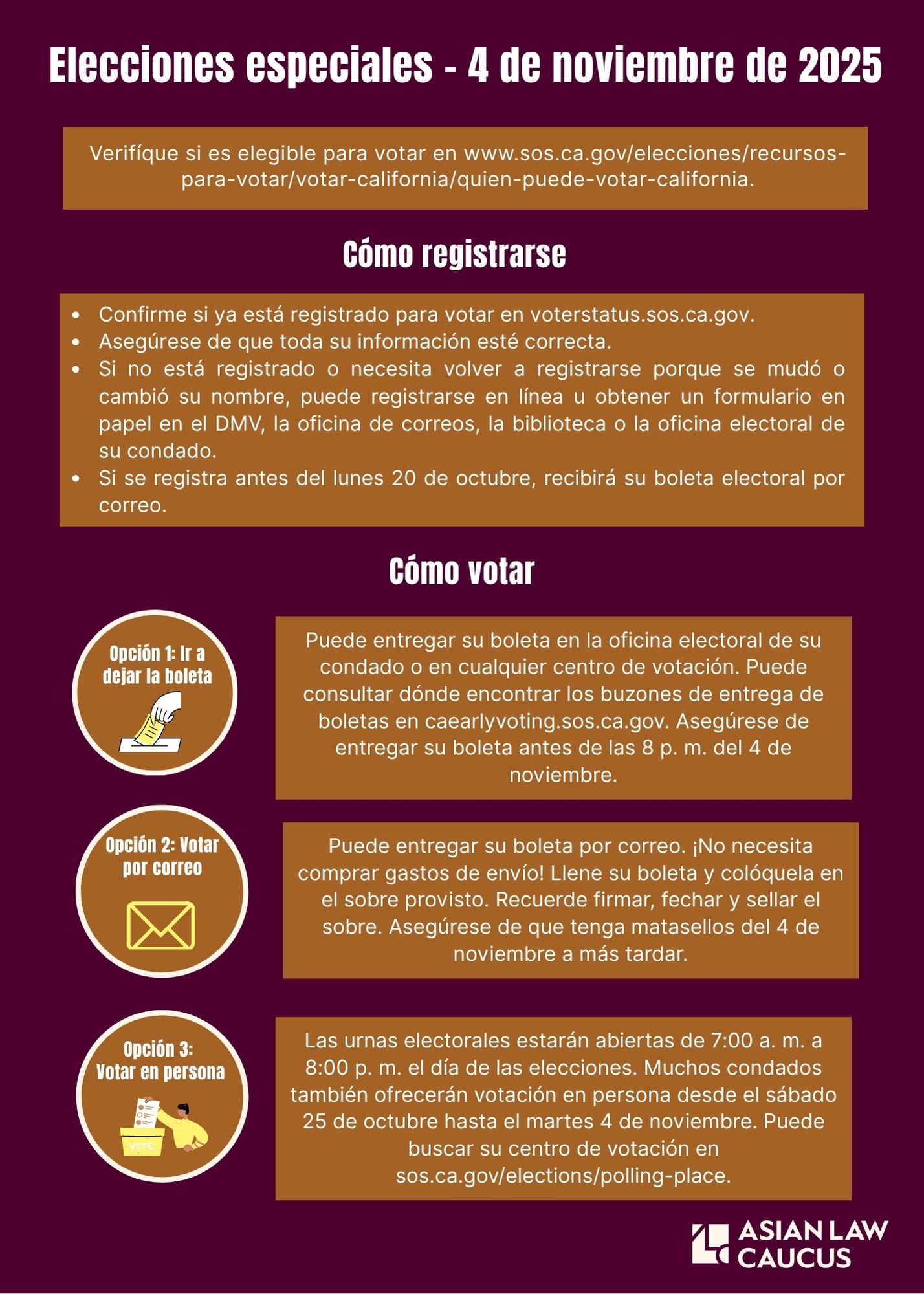
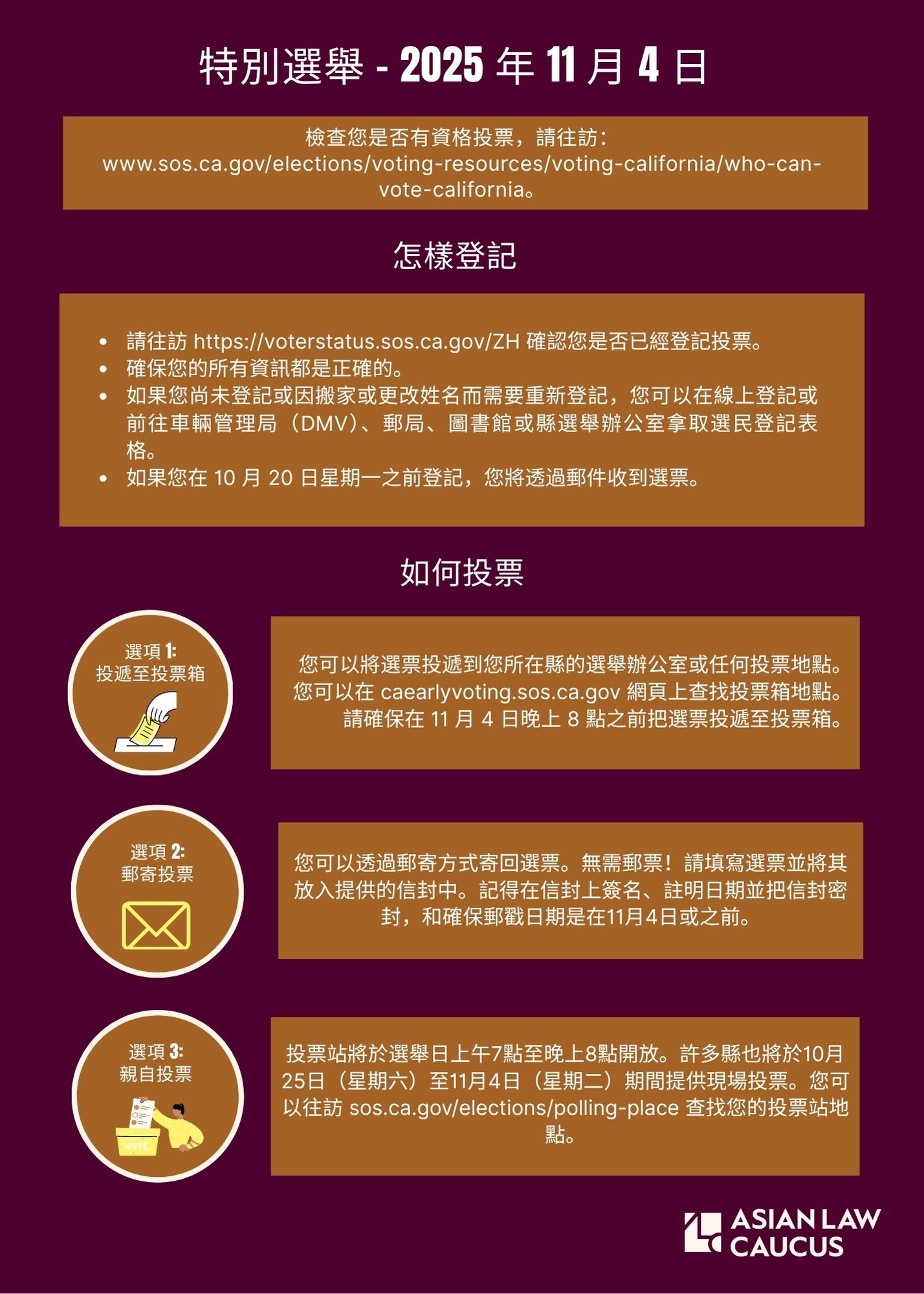
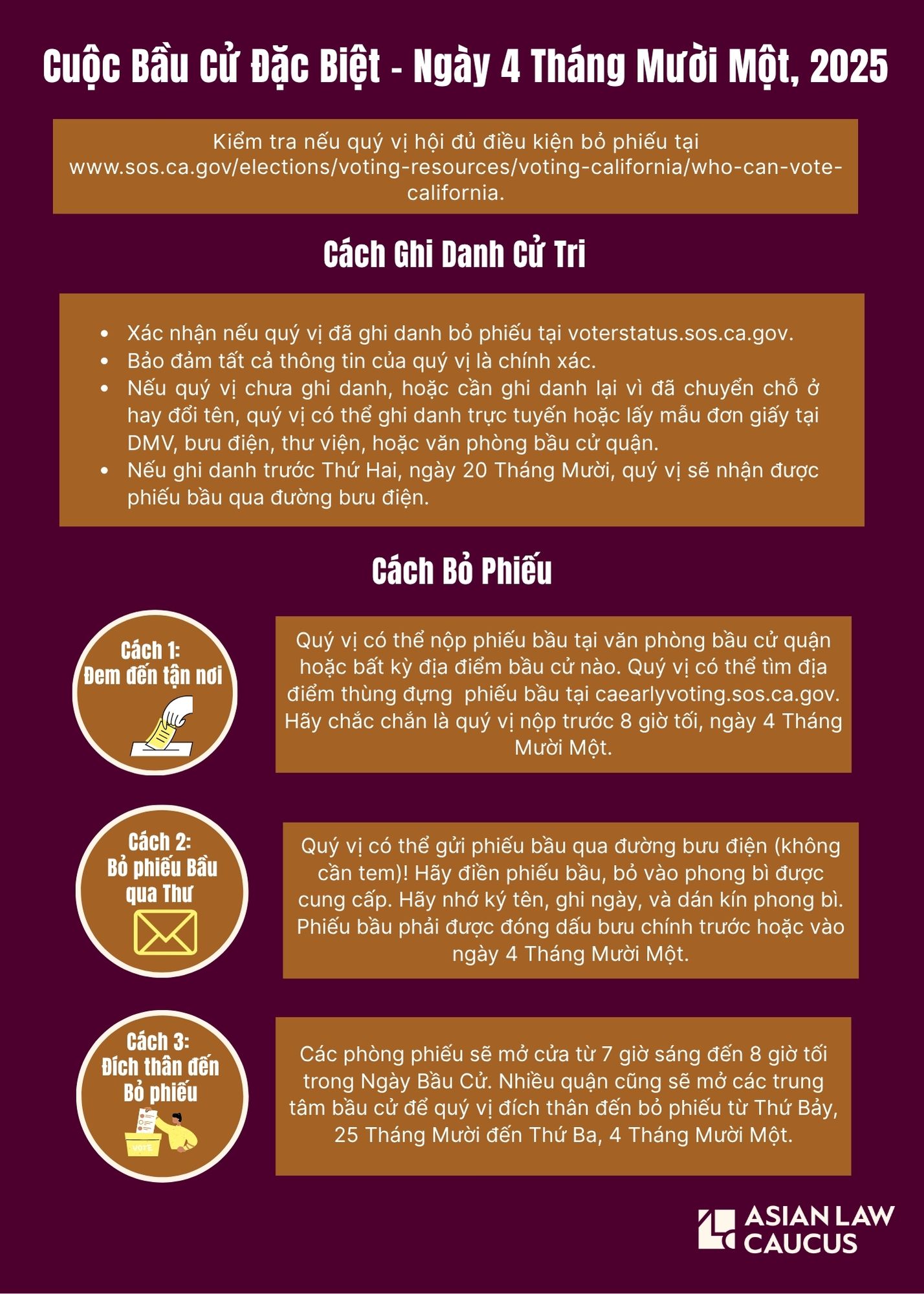
- How to Vote Factsheet | Also available in Arabic, Hmong, Korean, Simplified Chinese, Spanish, Tagalog, Traditional Chinese, Vietnamese
- “See How My District May Change” Interactive Map (scroll down)

Frequently Asked Questions
Voting in the Special Election
When is the special election?
Election Day is on November 4, 2025. You can vote as early as October 6 at most county elections offices. And many counties open polling locations from Saturday, October 25 through Tuesday, November 4. Check with your local elections office or look up voting locations at caearlyvoting.sos.ca.gov.
Am I eligible to vote?
To vote in the upcoming special election, you must first be registered to vote. You can register if you meet all of the following requirements. You must be:
- A U.S. Citizen and a resident of California
- 18 years or older on Election Day
- Not currently serving a state or federal prison term for the conviction of a felony
- Not currently found mentally incompetent to vote by a court
I’m not registered to vote. When is the registration deadline?
- Until October 20, you can register to vote online at registertovote.ca.gov or get a form at the DMV, post office, library, or your county elections office. If you miss the deadline, you can still register and vote in person.
- You can register and vote in person at your polling place on Election Day. In some counties, you can also register in person and vote at your polling place before Election Day. Look up voting locations at caearlyvoting.sos.ca.gov.
How and where can I vote?
Ballots will be mailed to all voters registered by October 20. There are three main ways to cast your ballot: vote by mail, drop it off at a voting location or a secure drop box, or vote in person.
- Drop it Off: You can drop off your ballot at your county elections office or any voting location. You can look up drop boxes at caearlyvoting.sos.ca.gov. Make sure you drop it off before 8 p.m. on November 4.
- Vote by Mail: You can return the ballot by mail. No postage needed! Fill out your ballot, place it in the provided envelope, and sign, date, and seal the envelope. Make sure it is postmarked by November 4.
- Vote In-Person: Election Day is Tuesday, November 4, 2025. Polls will be open from 7 a.m. to 8 p.m. Look up your polling place at sos.ca.gov/elections/polling-place.
- Many counties will also offer in-person voting from Saturday, October 25 through Tuesday, November 4. Check with your local elections office or look up voting locations at caearlyvoting.sos.ca.gov.
When will I get my ballot?
Elections offices will begin mailing ballots by October 6. If you are registered by Monday, October 20, you will receive your ballot in the mail.
Proposition 50 and Redistricting
Why is the special election happening? What’s on the ballot?
Across California, Proposition 50 will be on the ballot for voters to decide whether to approve new Congressional lines for upcoming elections. Congressional lines determine which district you live and vote in when you choose your elected leader in the U.S. House of Representatives. Proposition 50 was introduced and approved by the Governor of California and the California state legislature as a direct response to redrawn lines by Texas state legislators that created new Republican Congressional seats.
Some places will also have local measures on the ballot.
I keep hearing about redistricting when people talk about Proposition 50. What is that?
- Redistricting is the redrawing of the boundary lines that define the political “districts” in which people live and vote. Every 10 years, after the U.S. Census, redistricting balances out the number of residents who live in each district in a jurisdiction. For example, redistricting addresses population changes by equalizing the number of people in a county’s supervisorial districts. Post-Census redistricting happens at every level of government where a jurisdiction has districts. California redistricted its congressional districts in 2021.
- The district lines not only determine which district you live in, but they also often influence who wins an election and what policies will be prioritized. That’s because a district’s make-up can determine such things as whether it contains more renters or homeowners, more liberals or conservatives, more urban dwellers or suburbanites - all factors that can affect who runs for office and who is likely to win an election.
- Redistricting does not change what county or city you live in.
- Proposition 50 proposes what is called “mid-decade” redistricting, which is different from the traditional ten-year redistricting process.
Does Proposition 50 affect any other level of government?
No, if Proposition 50 passes, it will only affect California’s U.S. House of Representative districts (also known as congressional districts). It cannot affect any other level of government. In other words, it will not affect your state senate, assembly, county supervisor, city council, or school board district.
For Proposition 50, what does a Yes vote mean and what does a No vote mean?
- A Yes vote supports the adoption of new congressional lines.
- A No vote opposes the adoption of new congressional lines.
How many votes are needed for Proposition 50 to pass?
Proposition 50 will pass if more than 50% of those who vote in the special election vote yes.
What congressional districts would significantly change if Proposition 50 passes?
For an interactive map of the existing lines and the proposed new lines, go to: https://harvard-cga.maps.arcgis.com/apps/instant/sidebar/index.html?appid=d0d079d11395406a949564734ef62aed
Will my congressional district change if voters approve Proposition 50? How?
Find out if and how your congressional district is going to change by searching by your address at: https://calmatters.org/politics/2025/08/find-out-if-your-vote-could-be-affected-by-newsoms-redistricting-plans.
If Proposition 50 passes, how long will the new congressional districts be in place?
- The new districts will be in place from 2026 until the next redistricting cycle in 2031.
- In 2026, there will be an election for every House of Representative seat in the country. If Proposition 50 passes, the new districts would apply when California holds its primary election in June 2026.
What happens if Proposition 50 fails?
If voters do not approve Proposition 50 by majority vote, California’s current congressional district lines will remain in place until 2031.
Does California have a statewide independent redistricting commission?
California has a statewide independent redistricting commission that draws the lines for the Assembly, State Senate, and Congress every 10 years. While this commission did not participate in the mid-decade redistricting, Proposition 50 confirms the commission will once again draw the lines in 2031.
What other states are doing mid-decade redistricting?
As of September 2025, the following states have either redrawn their congressional districts or have discussed it: Texas, Missouri, and Ohio. Other states that might redistrict are Florida, Illinois, Indiana, Kansas, Maryland, South Carolina, and Utah.
Additional resources
- 2025 Statewide Special Election Resources, California Secretary of State
- Easy Voter Guide, League of Women Voters California
- “Will your congressional district change if voters pass Newsom's plan?," CalMatters