This Know Your Rights page provides information regarding how to prepare for travel in U.S. airports, whether you are planning to travel internationally or within the United States. It also provides information letting you know what your rights are if you are searched, questioned, detained, or denied entry at a US airport. The information below can be subject to change based on new policies implemented under the current administration. Please revisit this page regularly for the most up-to-date information regarding travel rights.
Printable resources in English and Spanish are below.
Advisory regarding all airport travel
7/24/2026 Update: In the past two weeks, we have received increased reports of ICE (Immigration and Customs Enforcement) detaining noncitizen travelers at airports, including travelers who have pending immigration court cases and/or pending affirmative benefit applications. Incidents have occurred before and after landing on domestic flights. Previously, airport immigration detentions focused on individuals with removal orders or administrative warrants.
Based on these reports, and out of an abundance of caution, we strongly recommend that:
- Noncitizens with pending immigration court proceedings and temporary visas, in addition to noncitizens with old removal orders or criminal history, consult with an immigration attorney who is aware of recent immigration enforcement at your departure and arrival airport before travel
- Individuals who do not have any immigration status avoid airport travel, including domestic travel due to the risk of immigration enforcement
The Transportation Security Administration (TSA), which is the federal agency responsible for airport security, now shares passenger information with ICE. ICE can use this information to target individual travelers for immigration arrest at airports.
Travelers at a particularly high risk of detention include individuals who do not have current immigration status (including those with pending immigration court cases and/or pending applications with USCIS), travelers whose immigration status has expired or been terminated, and travelers with old removal orders. Even if you now have some form of immigration status (like withholding of removal or Convention Against Torture protection), you could be targeted by ICE if you have a removal order.
You also could be targeted if ICE has a warrant against you, which can happen even if you have lawful status. For example, even as a lawful permanent resident you could face an immigration arrest if you have had contact with the criminal legal system, including arrests, convictions, and even expunged convictions.
How to prepare for air travel (domestic or international)
Please note that this information offers general recommendations for deciding whether to travel by air in the U.S. and how to prepare for air travel. It does not constitute legal advice.
- Assess your risk: Determine whether ICE could have a legal basis to detain you – and whether your immigration status puts you at high risk of being detained at an airport (even if ICE does not have a legal basis to detain you, see more below). The best way to do this is to consult with an immigration attorney.
- Even if you have temporary legal status in the U.S. – including, for example, a pending application in immigration court and a work permit (EAD) or a temporary visa, you could be targeted for immigration enforcement at airports. We recommend that you consult with an immigration attorney who has knowledge of recent immigration enforcement activity at your planned departure and arrival airport.
- You can call the Executive Office of Immigration Review automated hotline (1-800-898-7180) or visit the EOIR website to learn if you have a removal order. To find this information, you will need to know your A-number, which is a nine-digit number assigned to you by immigration officials.
- Make sure to bring legal identity documents to the airport. It can also be helpful to bring important immigration documents that show you are legally allowed to be present in — and enter into — the United States. (Note: This type of documentation can be important for international travel, and can be a good idea to bring when traveling domestically.)
- US Citizens: your passport
- Lawful Permanent Residents: your foreign passport, permanent resident card, also known as a “green card”, and a Form G-28 (form filled out by your immigration attorney)
- Visa Holders: your foreign passport, visa, Form I-94 (arrival/departure record), Form I-20 (proof of student status for student visas), Form I-797 visa approval notices, Form G-28 (form filled out by your immigration attorney) and any other important immigration documents.
- If you are a visa holder, we recommend you consult with an immigration attorney before airport travel.
- Send your itinerary and your immigration attorney’s contact information to a family member or friend.
- Print out your itinerary, your immigration attorney’s contact information, and your emergency contact information and bring it with you.
- Be prepared for the possibility of questioning and delays.
- Important information for DOMESTIC (not international) travel:
- TSA may physically search you and question you about your identity and belongings. You have the right to wear your religious head covering if asked to remove it. You have the right to request that any pat-down or removal of your head covering be conducted by a person of your gender and that it occur in a private area.
- In California, and in other sanctuary states, TSA agents cannot ask you about your immigration status. Consult this map to determine what laws apply in the state you are in.
Frequently Asked Questions
INTERNATIONAL TRAVEL
What are my rights at a port of entry when I return to the U.S. after traveling internationally?
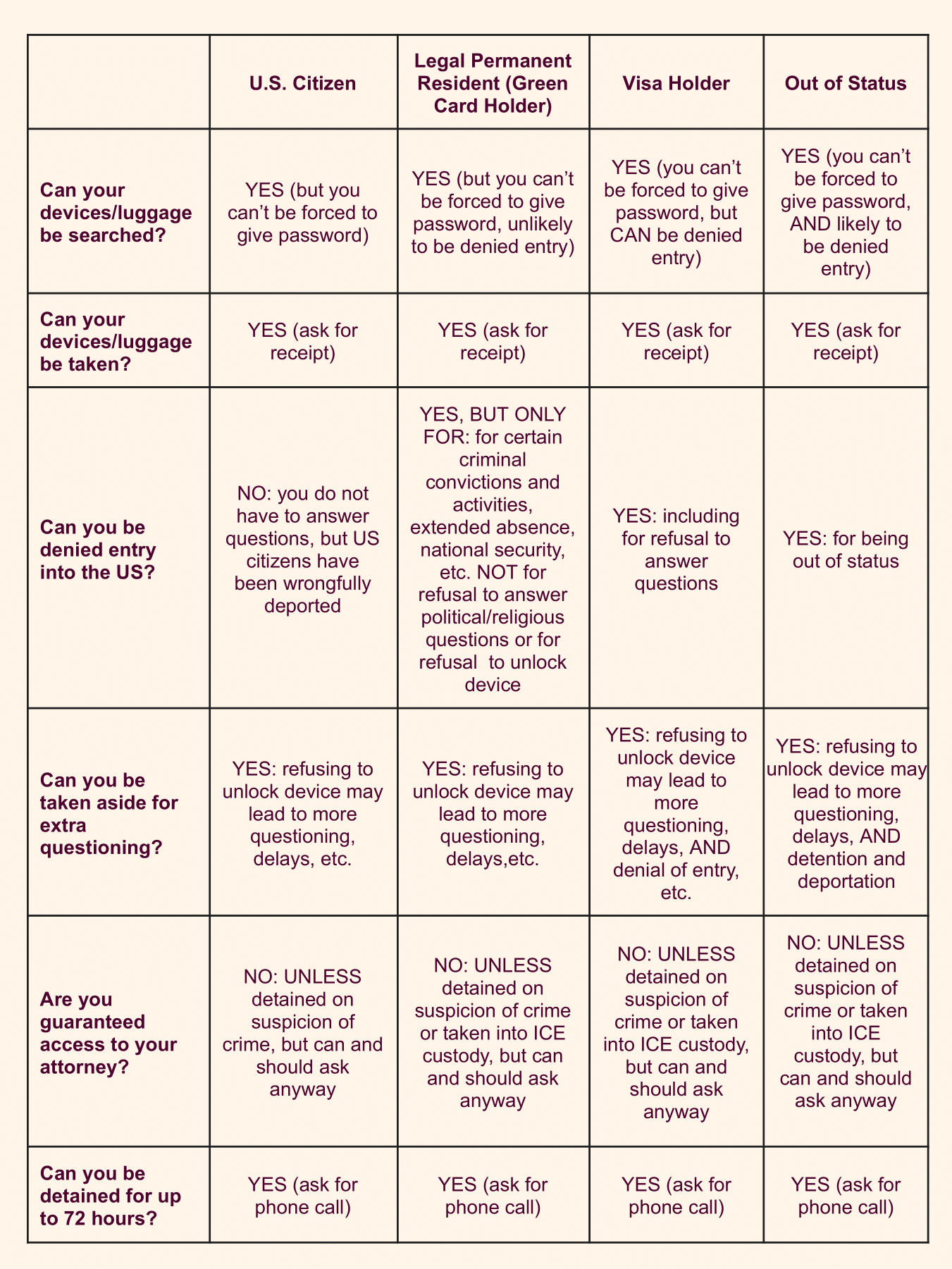
This chart generally describes whether you can be searched, whether your devices can be taken, whether you can be denied entry, questioned, provided access to an attorney, or detained at a port of entry, which is the place where you re-enter the country after traveling internationally. (If you travel by air, the port of entry is inside the airport, immediately after you get off the plane.) This chart does not constitute legal advice.
Who can be denied entry to the U.S.?
Anyone, EXCEPT for U.S. citizens, can be denied entry to the U.S.
- Out-of-status individuals have the fewest rights and are likely to be denied entry to the U.S. for being out-of-status.
- Visa holders can also be denied entry for refusing to answer questions, for refusing to unlock a device, and for many other reasons.
- Lawful permanent residents are unlikely to be denied entry into the U.S. However, they can be denied entry for certain criminal convictions, extended absence (more than six months), or for national security reasons. There have been recent cases of green card holders being sent straight into ICE custody from airports due to past criminal convictions. Green card holders CANNOT be denied entry into the country for refusal to answer political/religious questions or for refusal to unlock their device. Consult an attorney for individualized advice.
- U.S. citizens CANNOT be denied entry into the U.S.
What factors might make it more likely for me to be searched, questioned, or detained at a port of entry?
You can still be searched, questioned, denied, or denied entry even IF these situations don’t directly apply to you. These are just some of the possible factors that MAY make it more likely that you will be searched, stopped, questioned, or detained.
- Criminal history, past convictions, or ongoing criminal investigation. If this applies to you, it is best to consult with an attorney with criminal and immigration expertise before you travel.
- Recent travel to a country that is subject to the “Expanded Travel and Immigration Ban,” or that the U.S. deems to be connected to terrorism, drug trafficking, or sex tourism. A history of travel to such countries can also raise suspicion. However, even others who don’t have this history of travel have been searched, questioned, detained, and denied entry. Consult an attorney if you believe this applies to you.
- Having an application pending with the U.S. Citizenship and Immigration Services (USCIS) or having a case open with the Executive Office for Immigration Review (EOIR).
- Having anything in your immigration history that was not disclosed during your immigration process or that might cause a government official to question you about the reason for your travel or about your immigration history. For example, if you overstayed in the US on a visa in the past.
- Racial profiling and religious discrimination mean that if you are from a historically marginalized racial or religious community, you may be more likely to be targeted for searches. This includes if you wear a hijab, Sikh turban, kafi, keffiyeh, or another type of religious/cultural garment or symbol. CBP officers may consider your race and religion, along with other factors, when deciding to search, question, or detain you at a port of entry. They cannot detain you SOLELY based on your race or religion.
- If you believe you have been targeted for a search due to your race or religion, keep a record with all the details of the incident that you can remember, including names or identifying information of the officials involved, receipts for confiscated property, names and contact information of any witnesses.
- Contact ALC.
How can I prepare for searches of electronic devices when traveling internationally?
CBP can search, copy, or even take your electronic devices - including smartphones, laptops, and tablets - at a port of entry. CBP might conduct what’s often called a “basic search” on the spot. They might also download the full contents of your device and save a copy of your data. They might choose to send away your device for a more thorough “advanced” or “forensic” search. This includes smartphones, laptops, and tablets.
To protect yourself and your devices, consider the following:
- If possible, consider traveling without your electronic devices or carry a device used only for travel.
- If that is not possible, secure your device.
- Use a password, instead of facial/retina and fingerprint scan features.
- Employ a strong password (15+ characters).
- Store sensitive data in an end-to-end encrypted cloud-storage account (like iCloud or Proton Drive).
- Once you have crossed a port of entry and entered the United States, you can restore your data, so long as the backup is stored in a secure location.
- Remove any sensitive data from your device. However, know that deleting data will not ensure your privacy. Most government agencies are able to recover deleted data.
- Use a password, instead of facial/retina and fingerprint scan features.
- Keep your device off and tucked away, or in airplane mode.
- If you have any privileged or sensitive material on your device, tell the officers: “I have privileged material on my device.” If applicable, provide identification showing that you are a professional required to maintain confidentiality.
- For more information about digital security when traveling consult the following resource.
What should I know if I do not wish to consent to a search of my electronic device?
If you do not consent to a search, your risk varies greatly depending on your immigration status.
- If you are a visa holder, you risk being denied entry at a port of entry if you refuse to consent to a search.
- If you are a lawful permanent resident or green card holder you have less risk of being denied entry. However, on occasion, green card holders have been detained and sent into ICE custody because of a criminal conviction, because they left the US for more than six months, or because they were deemed a threat to national security.
- If you are a citizen, you cannot be denied entry if you refuse to consent to a search.
If you do not consent to a search, say so, even though this may not be honored. Refusal to provide a password or unlock a device may lead to delays or additional questioning. However, there’s no guarantee that unlocking the device or providing a password will shorten the questioning or advance the process.
Know the following:
- U.S. citizens cannot be denied entry or arrested for refusing to provide a password or unlock a device, but their device can be taken for a search.
- Lawful permanent residents can be detained and placed in removal proceedings for certain criminal convictions, extended absence from the country, or for national security reasons, but NOT for refusing to provide a password or unlock a device. Their device can also be taken for a search. If CBP takes your green card, you have the right to other evidence of your LPR status, such as a stamp in your passport. CBP cannot revoke your green card; only an immigration judge can do that.
- Visa holders can be denied entry for refusing to provide a password or unlock a device.
- If you do not want to consent, ask questions to clarify what you are being told to do and what the scope of the search is.
- For example, ask the officer: “Are you ordering me to unlock my phone?”
- If they say yes, you can say: “I refuse your request and do not consent to a search of my phone.”
- If they say no, but suggest that if you do unlock your phone, the process will go quicker, you should weigh the risks and benefits based on your particular situation (immigration status, travel history, criminal history, etc.). Then say either:
- “No, I do not agree to your request and do not consent to a search of my phone.” OR
- “Yes, you may unlock my phone.”
What should I know if I do decide to consent to a search of my electronic device?
If you do consent to a search and provide your password:
- CBP might conduct a basic search of your device on the spot. They may also download your device’s data. They may give your device back after a few minutes or hours, or they may keep it for many days.
- If you have any privileged or sensitive material on your device, tell the officers: “I have privileged material on my device.” If applicable, provide identification showing that you are a professional required to maintain confidentiality. For more information on protecting privileged information, consult the following resource.
- Take careful note of the official conducting the search, and if any items are taken out of your field of vision.
- Ask for the official’s full name, agency, badge number, and identification and write down that information.
What do I do if any of my personal devices are taken by CBP?
If your device is taken, agents may view all of the content stored in your device, manually or with powerful forensic software. CBP agents may copy and store all of this content for their later use. This may take anywhere from a few days to months. Consider purchasing replacement devices, and plan for the fact that you will not have access to the information on the devices while the government has them.
If your property is taken:r
- Ask for the agent’s names, badge numbers and which agency they work for.
- Call the agency later to request a receipt documenting that a personal item was taken away if you didn’t get a receipt in the moment.
- If you gave any usernames and passwords to an agent, change your login and password information later.
What should I know about physical searches at airports and ports of entry?
For physical searches, know the following:
- Photos and body scans: You can ask to opt out of having your photo taken or your body scanned when traveling.
- Simply say: “I would like to opt out.”
- You may be asked why. Say: “I do not feel comfortable having my photo taken.” or “I do not feel comfortable having my body scanned.”
- You may be subject to physical pat down if you opt out of a body scan.
- Strip searches: Officers can only do strip-searches if they suspect that you are involved in criminal activity. Strip-searches must be done in a private area. You may request that the search be done by a person of the same gender.
- Physical searches: You have the right to wear your religious head covering if asked to remove it. You have the right to request that any pat-down or removal of your head covering be conducted by a person of your gender and that it occur in a private area.
- If you do not want CBP or Transportation Security Administration (TSA) officers to touch your religious head covering, say: “I do not want you to touch my religious head covering. I would prefer to pat it down myself.”
- You will then be taken aside and a TSA officer will supervise you as you pat down your religious head covering.
- After the pat-down, the TSA officer may rub your hands with a small cotton cloth and place it in a machine to test for chemical residue. If you pass this chemical residue test, you should be allowed to proceed to your flight.
If you are searched in a way that you think may be illegal, or if you were searched without your consent, keep a record with all the details of the incident that you can remember, including names or identifying information of the officials involved, receipts for confiscated property, names and contact information of any witnesses. Contact ALC to determine if you qualify for legal representation.
How does questioning occur at a port of entry?
Each person who arrives at a port of entry is typically subjected to routine questioning. Initially, agents may ask for your ID or question you about the basic details of your trip, such as its purpose, itinerary, destination, and duration. You should answer these questions truthfully, and answer the question being asked; there is no need to volunteer any additional information.
After this, depending on your circumstances, you may be flagged for “secondary inspection”--which is when you will be taken aside into a room and questioned further. Secondary inspection may include questioning about your religious views, your political beliefs, and who you met and what you did on your travels. You may be questioned about your social media activity and other political activity, especially if you posted or wrote publicly about political topics. If your phone or laptop is searched, you may be questioned about your photos and videos, your text messages, Whatsapp messages, WeChat messages, files, emails, among other things.
To prepare for this, consider doing the following:
- Before traveling, consider providing a trusted friend and family member with your immigration attorney’s contact information.
- This way, if you are pulled aside, you can text a friend in the US: “I'm being pulled into secondary inspection, contact my lawyer."
What should I do if I am questioned at a port of entry?
If you do not wish to answer extra questions, consider the following:
- If you are a US citizen or lawful permanent resident (green card holder) and do not wish to answer questions about politics, religion, or who you know, you can say: “I am not comfortable answering questions about my religious or political beliefs, or about who I know.”
- If you are a lawful permanent resident, know that you have certain constitutional rights; however, you should consult an immigration attorney if you have concerns about being flagged for your criminal history, immigration history, extended absence, or for national security reasons.
- If you are a visa holder, you can consider refusing to answer questions, but you may be denied entry to the U.S. as a result of refusing to answer questions.
- Consider asking for your attorney when pulled aside and showing your Form G-28, also known as the Notice of Entry of Appearance as Attorney or Accredited Representative.
- Typically, CBP officials cannot lawfully arrest you solely based on your refusal to answer questions but please note:
- If you are a U.S. citizen, refusal to answer questions can delay your entry into the United States.
- If you are a lawful permanent resident, refusal to answer questions should not result in denial of entry. However, you may be denied entry for other reasons, including criminal convictions, extended absence, or for national security reasons.
- If you are a visa holder, you may be denied entry outright for refusing to answer questions.
- If you feel you must answer questions, answer only the question being asked and answer it directly and truthfully.
- Answers could be:
- Yes.
- No.
- I don’t know.
- I don’t remember.
- Do NOT lie.
- Answers could be:
Will I get access to an attorney at a port of entry?
Generally, there is no right to an attorney at a port of entry. You may or may not receive access to an attorney at a port of entry upon request. Under certain circumstances, you have the right to an attorney–for example if you are suspected of a crime, or if you are taken into ICE custody.
- If you believe that you are being detained on suspicion of a crime:
- Ask: “Am I being detained on suspicion of a crime?”
- If the answer is yes, do not answer any questions and ask for an attorney immediately.
- Ask: “Am I being detained on suspicion of a crime?”
- If you believe you are going to be taken into ICE custody, do not answer any questions and ask for an attorney immediately.
- Consider asking for an attorney if you are being subjected to a search that seems too long, or extra questioning, though you may not be allowed to contact your attorney. However, you can ask anyway.
- Keep your attorney’s contact information with you on a piece of paper when traveling.
Can I be detained at a port of entry?
Yes, you can be detained at a port of entry. Typically, a person can be detained for up to 72 hours at a port of entry. You can also be transferred to criminal custody or ICE custody.
- IF you believe that you are being detained on suspicion of crime:
- Ask: “Am I being detained on suspicion of a crime?” If the answer is yes, you have the right to remain silent and not answer any questions; also you should ask for an attorney immediately.
- IF you believe you are going to be taken into ICE custody, ask: “Am I being taken into ICE custody?” If the answer is yes, you have the right to remain silent and do not answer any questions; and also you should ask for an attorney immediately.
- If you are detained at a port of entry, you have the right to contact the consulate of the country you are a citizen of for assistance.
- If a few hours have passed, consider asking for a phone call, to call your attorney.
- Do not sign any document without having a lawyer review it.